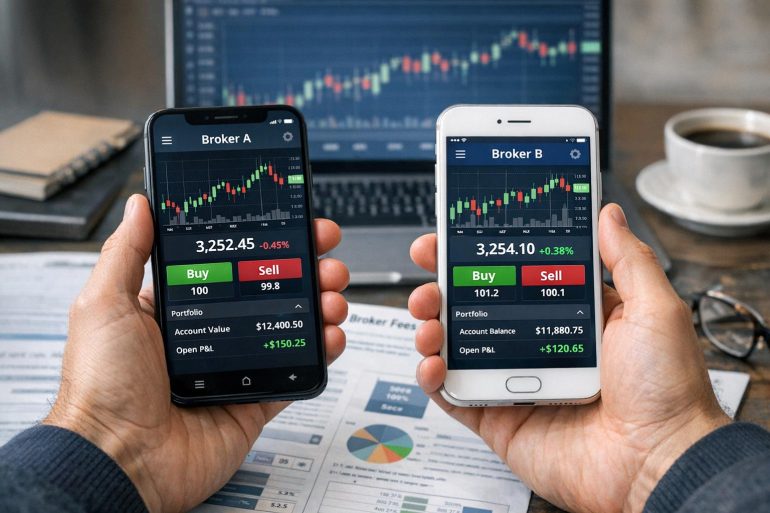
Understanding the Context of Mobile Trading
Mobile trading has shifted from being an auxiliary channel to becoming the primary interface for many retail investors. Smartphones now provide access to global markets, real-time pricing feeds, advanced charting packages, and order execution systems that operate with minimal latency. For a growing segment of market participants, the mobile application is not a secondary access point but the central operational environment through which all portfolio activity is conducted.
This shift requires a recalibration of how brokers are compared. In earlier years, desktop platforms defined the competitive standard, with mobile applications functioning mainly as simplified extensions. Today, many brokers develop mobile-first infrastructures, prioritizing app optimization before desktop refinement. Comparing brokers for mobile trading therefore requires direct scrutiny of their mobile ecosystem rather than assuming parity with desktop offerings.
Mobile trading environments present distinct technical constraints. Screen size, operating system differences, network variability, and app-store update cycles all influence performance. A broker that performs well on a web terminal may not deliver equivalent reliability on handheld devices. Careful evaluation must consider not only available features but how well they function within the mobile operating environment.
Additionally, mobile trading introduces behavioral implications. Because traders can access markets at any time, the platform must support disciplined risk management rather than encourage fragmented or impulsive execution. Clear portfolio visibility, accessible stop-loss editing, and transparent reporting contribute to maintaining structured oversight.
Regulation and Security Infrastructure
Before evaluating functionality or interface design, traders should analyze the broker’s regulatory standing. Regulation establishes the procedural framework governing how client funds are handled, how trade execution is monitored, and how disputes are resolved. A broker authorized by reputable regulatory bodies is typically subject to capital adequacy requirements, periodic audits, and client fund segregation rules.
Client fund segregation is particularly important. Regulated brokers are required to separate customer deposits from corporate operating accounts, reducing the risk that business liabilities compromise client assets. Investors should review official regulatory disclosures to confirm licensing status rather than relying exclusively on promotional descriptions within the app store listing.
Mobile trading also introduces cybersecurity requirements that differ slightly from traditional desktop usage. Public wireless networks, device theft, and phishing risks create additional vulnerabilities. A secure broker application should incorporate two-factor authentication (2FA), which may involve SMS codes, authenticator applications, or hardware-based confirmation. Biometric authentication such as fingerprint scanning or facial recognition can further restrict unauthorized access.
Encryption protocols protect data transmission between the device and the broker’s servers. Industry-standard encryption layers, secure session token management, and automatic logout after periods of inactivity reduce attack surface exposure. Some brokers provide device management dashboards, allowing users to view active login sessions and terminate any unrecognized device connections.
Security also includes internal fraud detection and transaction monitoring systems. Suspicious withdrawal patterns, repeated login attempts, or location anomalies may trigger automated safeguards. Reviewing regulatory filings or corporate transparency reports can provide insight into how the broker addresses cybersecurity risks at an institutional level.
Mobile Platform Usability
The usability of a mobile trading application directly affects operational efficiency. Limited screen space requires thoughtful layout management, logical icon placement, and responsive design transitions. Traders must be able to access watchlists, account summaries, chart analysis tools, and order entry screens without excessive menu navigation.
An effective mobile interface emphasizes clarity. Price changes, order confirmations, and margin utilization figures should be distinctly visible. Overcrowded dashboards increase the likelihood of execution errors. The speed at which traders can move between asset views is particularly important during volatile periods when decision windows are narrow.
Responsiveness is another determining factor. The application should load charts smoothly, scroll without latency, and execute orders within expected network speeds. Testing performance during active market hours, including periods of elevated volatility, provides more accurate insight than testing solely during low-volume intervals.
Cross-device synchronization adds further operational continuity. Traders who alternate between desktop and mobile platforms benefit from synchronized watchlists, chart templates, saved indicators, and alert configurations. Without seamless synchronization, a position monitored on one device may not reflect updated parameters on another, creating unnecessary complexity.
Operating system compatibility should also be verified. Some features may appear first on one platform before being rolled out globally. Reviewing update frequency in app stores may reveal how actively the broker maintains and improves the application.
Order Execution and Trading Tools
Order execution quality substantially influences trading outcomes. Mobile applications should provide straightforward access to standard order types such as market orders, limit orders, stop-loss orders, and take-profit orders. The accessibility of these tools is crucial; traders must be able to modify stops or close positions quickly without navigating several menu layers.
Advanced order features can enhance strategic control. Trailing stops, conditional triggers, or bracket orders enable structured risk management directly from the mobile device. For active traders, the ability to adjust order parameters through intuitive sliders or editable price fields improves accuracy under time constraints.
Execution models differ among brokers. Some operate under a market maker model, internalizing client orders, while others follow an agency execution framework, routing trades directly to liquidity providers. Transparency regarding execution methodology and slippage statistics supports informed comparison. Published execution speed metrics and order fill ratios can provide objective benchmarks.
Charting functionality on mobile platforms must balance simplicity with analytic depth. Essential features include multiple time frames, common indicators such as moving averages or relative strength indexes, and drawing tools for trend lines or support levels. Although mobile charting may not replicate full desktop analytic complexity, it should allow comprehensive review of core price patterns.
For traders dealing in derivatives, additional modules may be required. Options traders may need profit-loss diagrams, implied volatility data, and pricing greeks accessible within the mobile interface. Futures traders require contract rollover visibility and margin requirement transparency. The broker’s ability to integrate such advanced tools into a stable mobile environment distinguishes more sophisticated platforms.
Fees and Cost Transparency
A detailed cost analysis is fundamental when comparing brokers for mobile trading. Advertising statements highlighting zero-commission structures do not always reflect the complete fee environment. Effective comparison requires examination of the total effective trading cost.
Spreads represent indirect costs embedded within price differences between buying and selling quotes. Wider spreads may offset commission-free claims. Active traders should calculate how spread variability during volatile sessions affects overall transaction expenses.
Additional costs may include inactivity fees, currency conversion charges, overnight financing rates for leveraged positions, and withdrawal processing fees. Margin borrowing rates can differ significantly across brokers and may influence long-term holding strategies involving leverage.
Transparency is measured not only by cost levels but by clarity in disclosure. Fee schedules should be easily accessible within the mobile app or official documentation. Clear breakdowns on trade confirmation screens allow traders to understand commission charges, taxes, and regulatory fees prior to confirmation.
Some brokers provide tiered pricing structures where higher trading volumes reduce commissions. Investors comparing mobile brokers should determine whether such volume-based models align with their anticipated trading frequency.
Asset Availability and Market Access
The breadth of tradable instruments accessible via mobile platforms varies considerably between brokers. While most mobile apps offer equities and major exchange-traded funds, not all provide equivalent coverage of bonds, options, futures, commodities, foreign exchange pairs, or digital assets.
Mobile-specific limitations sometimes restrict complex instruments to desktop environments. Traders who rely exclusively on mobile access must confirm that order placement, charting, and reporting for all desired asset classes are fully integrated within the app.
International market access introduces additional variables. Some brokers provide exposure to foreign exchanges through direct listings, while others offer synthetic access via depositary receipts or derivatives. Currency conversion policies, settlement periods, and taxation reporting obligations differ based on the chosen structure.
Market data depth also influences accessibility. Level II pricing, order book depth, and intraday historical data may require subscription upgrades. Traders engaging in short-term strategies often rely on detailed market depth information, so confirming availability within the mobile platform is advisable.
Research and Analytical Resources
Integrated research capability enhances independent decision-making. Mobile trading applications increasingly include earnings calendars, corporate financial statements, macroeconomic calendars, and industry analysis dashboards. The quality of these tools depends on data timeliness, accuracy, and structured presentation.
Fundamental data should include revenue figures, earnings per share statistics, balance sheet summaries, and analyst consensus projections. The ability to switch between quarterly and annual data presentations assists in longitudinal analysis. Economic calendars that outline interest rate decisions, employment reports, and inflation releases help contextualize price movements across asset classes.
Push notifications serve as operational extensions of research functionality. Customizable alerts for price thresholds, abnormal volume activity, or earnings announcements allow traders to react promptly. The option to tailor notification timing and relevance reduces informational overload while preserving situational awareness.
Some brokers embed screening tools within their mobile applications. These scanners may filter assets based on valuation metrics, technical indicators, or dividend yields. While mobile screeners are often simplified compared to desktop equivalents, they can still facilitate structured portfolio review.
Platform Stability and Downtime History
Technical reliability remains a central evaluation factor. Platform outages during periods of elevated volatility may prevent timely execution or risk reduction. Brokers with frequent downtime reports present operational concerns for active strategies.
Investors may review historical service interruption records published by brokers or discussed in independent evaluations. Maintenance schedules announced in advance indicate structured system management, while unplanned disruptions during peak trading intervals suggest scalability challenges.
Server capacity and order-routing infrastructure determine the platform’s ability to process high volumes during market-moving events. Traders engaging in short-term or high-frequency activity require consistent responsiveness during earnings releases or macroeconomic announcements.
Backup mechanisms provide additional resilience. Some brokers maintain phone-based trading desks to allow order placement if digital systems fail. While not frequently used, the availability of alternative channels mitigates operational risk.
User Support and Service Accessibility
Customer support structures influence overall service reliability. Mobile users may encounter technical difficulties requiring immediate clarification, especially when trading leveraged instruments or international assets. Access to real-time support channels enhances operational continuity.
Common support mediums include live chat integrated within the app, email correspondence, and telephone assistance. Response times vary between brokers. Structured ticket tracking systems allow users to monitor issue resolution progress.
Support staff competence also matters. Clear explanations of margin policies, settlement procedures, or corporate action handling reduce misunderstanding. Brokers serving multinational clients may provide multilingual assistance, which can improve clarity in complex regulatory matters.
Availability beyond standard domestic business hours benefits traders accessing global markets. Currency and commodity markets operate continuously across time zones, so support responsiveness outside regional hours may be relevant.
Account Types and Minimum Requirements
Brokers often provide multiple account categories distinguished by deposit thresholds, commission schedules, or product access privileges. Evaluation of these structures should consider both capital availability and anticipated trading activity.
Minimum deposit levels can influence accessibility, but higher-tier accounts sometimes provide lower transaction fees or expanded research access. Determining whether additional services justify increased capital commitment requires quantitative comparison.
Margin requirements and borrowing rates vary across jurisdictions and account classifications. Mobile applications should clearly display real-time margin usage, maintenance thresholds, and liquidation triggers. Clear visualization of leverage exposure helps traders manage risk more effectively.
Certain brokers offer professional account classifications for experienced traders, which may include higher leverage ratios. Transition eligibility often depends on portfolio size, trading frequency, and regulatory criteria.
Integration with External Tools
Advanced traders occasionally rely on portfolio analytics platforms, algorithmic tools, or accounting software. Mobile brokers that provide data export functionality or application programming interfaces (APIs) enhance integration capabilities.
Importing trade history into external tax management software simplifies compliance reporting. The format and detail of downloadable statements determine how efficiently such integration occurs.
Banking integration also affects capital mobility. Processing times for deposits and withdrawals differ among brokers, influenced by payment method and jurisdictional regulations. Electronic transfers, card payments, and digital wallet options carry varying processing durations and potential fees.
Quick access to deposited funds supports timely response to market opportunities, while transparent withdrawal procedures preserve liquidity control.
Customization and Personalization
Mobile trading environments benefit from configurable layouts tailored to individual strategies. The ability to rearrange watchlists, group assets by sector, or prioritize high-volume instruments enhances informational clarity.
Chart customization may include indicator layering, color adjustments, and saved template profiles. Dark mode settings reduce visual strain in low-light conditions and reflect common user preferences.
Portfolio dashboards should present relevant metrics such as realized gains, unrealized returns, allocation percentages, and daily profit-and-loss figures. Traders employing margin strategies require visibility of leverage ratios and collateral utilization in real time.
Personalized notification settings allow targeted monitoring without excessive alerts. Filtering notifications by asset class or price movement range improves operational focus.
Educational Resources Available on Mobile
Educational resources embedded within mobile platforms support ongoing skill development. Structured tutorials explaining order placement, margin functionality, or asset class characteristics can improve platform familiarity.
Webinars, recorded lessons, and searchable glossaries contribute to knowledge reinforcement. Interactive modules, including simulated trading environments, provide low-risk opportunities to test strategy adjustments.
While experienced traders may focus less on foundational materials, transitioning into new instruments such as options or futures can require additional reference content. Accessibility of concise, fact-based educational documentation within the app reduces the need for external consultation.
Reviews and Independent Comparisons
External perspectives contribute contextual insight when comparing brokers. Patterns observed across numerous users may reveal recurring strengths or technical challenges. However, anecdotal reports should be interpreted alongside official disclosures to avoid disproportionate emphasis on isolated experiences.
Independent financial publications occasionally evaluate brokers using standardized metrics such as cost efficiency, research depth, and execution reliability. Cross-referencing these assessments with regulatory filings and direct demo testing enhances objectivity.
Consistency between external evaluation findings and personal platform experience provides stronger comparative confidence.
Testing Through Demo Accounts
Demo accounts enable structured appraisal without financial exposure. Simulated funds allow traders to evaluate interface navigation, execution sequences, and research accessibility under typical market conditions.
Although demo environments may not fully replicate real-world slippage or liquidity variability, they provide meaningful insight into platform architecture. Assessing order modification speed, chart responsiveness, and synchronization across devices during testing reveals practical strengths or constraints.
Time invested in demo evaluation offers measurable returns by reducing the likelihood of selecting an unsuitable operational platform.
Balancing Priorities Based on Trading Style
Different trading methodologies require different platform characteristics. Long-term investors often emphasize cost efficiency, dividend tracking, and comprehensive fundamental data access. Execution speed remains relevant but may be less critical than clarity of reporting and corporate action processing.
Short-term traders require rapid order routing, minimal latency, and precise chart interpretation tools. For strategies involving leverage, direct visibility of stop-loss modification and margin status becomes central.
Options and derivatives traders demand strategy-building interfaces, volatility data integration, and visual payoff representation within the mobile framework. International investors may prioritize multi-currency account capabilities and efficient foreign exchange conversion functions.
A structured comparison should begin with identification of strategy-specific requirements. Brokers should then be evaluated according to how effectively their mobile environments align with those operational criteria.
Conclusion
Comparing brokers for mobile trading involves systematic examination of regulatory credentials, cybersecurity infrastructure, execution transparency, cost structures, asset availability, and research support. Platform stability, integration flexibility, customer service responsiveness, and customization capacity further influence long-term suitability.
Mobile trading environments now function as comprehensive financial workstations rather than secondary access tools. However, accessibility does not eliminate the necessity for structured evaluation. Objective testing, transparent cost analysis, and regulatory verification remain central to broker comparison.
By aligning platform capabilities with clearly defined trading objectives and risk management standards, investors can identify mobile brokers whose infrastructure and services correspond to their operational requirements.
