Understanding the Role of a Broker in ETF Investing
A broker functions as the operational gateway between the investor and the exchange where exchange-traded funds are listed. Although ETFs are structurally simple instruments that trade intraday like shares, access to them depends entirely on brokerage infrastructure. The broker provides order routing, settlement processing, custody, reporting, and compliance oversight. Each of these components influences cost, efficiency, and administrative simplicity.
For ETF investors, the broker’s primary contribution lies in enabling consistent, cost-controlled portfolio implementation. Investors building diversified portfolios across asset classes, geographies, and sectors depend on reliable execution and secure asset custody. While advanced charting features or high-speed trading tools can be relevant for tactical traders, long-term ETF investors often derive more value from low operational friction and transparent policies.
The broker is also responsible for corporate action processing, dividend allocation, rights issues, and fund mergers. ETFs occasionally change benchmarks or merge with similar funds. A broker’s ability to process such events accurately ensures there is no unnecessary disruption to portfolio structure.
Fee Structure and Total Cost of Ownership
Cost comparison extends beyond visible transaction fees. The total cost of ownership of ETF investing through a broker incorporates commissions, implicit transaction costs, ongoing administrative charges, and foreign exchange spreads. Even modest recurring charges reduce compounded returns over a multiyear horizon.
Commissions and Trading Fees
Commission-free trading has become common in many developed markets. However, commission policies vary in detail. Some brokers restrict zero-commission status to domestically listed ETFs, while applying standard fees to foreign securities. Others limit free trades to a predefined list of partner ETFs. It is necessary to review whether commission-free access applies universally across exchanges and whether there are volume caps or inactivity conditions.
In jurisdictions where commissions are still prevalent, investors should evaluate how the fee schedule interacts with their expected trading frequency. A buy-and-hold investor contributing capital quarterly may be less sensitive to modest transaction charges than an investor implementing regular monthly rebalancing.
Bid-Ask Spread and Execution Quality
The absence of explicit commissions does not eliminate trading costs. The difference between the bid and ask price represents a direct implicit cost. Brokers route orders through various market venues or wholesalers. The quality of execution determines whether the client receives favorable price improvement relative to the quoted price.
Reputable brokers often publish execution quality statistics that outline average price improvement, percentage of marketable orders executed at or better than national best bid and offer, and average time to execution. For investors placing limit orders on liquid ETFs tracking broad indices, execution differences may be small. Nevertheless, over years of contributions and rebalancing trades, improved routing efficiency can incrementally enhance returns.
Account Maintenance and Custody Fees
While many large brokers have eliminated annual account fees, certain institutions continue to impose them. These may include inactivity fees, minimum balance requirements, or custody charges for holding foreign securities. Long-term ETF investors who trade infrequently should confirm that passive holding does not generate administrative costs.
Custody fees may also apply in cross-border situations. Investors holding ETFs on multiple exchanges should review whether additional safekeeping fees are imposed for international assets.
Currency Conversion Fees
Investors acquiring ETFs denominated in foreign currencies face foreign exchange costs. Brokers typically apply a markup to the interbank exchange rate. This markup may range from narrow spreads at institutional-style platforms to wider margins at retail-focused intermediaries.
Access to a multi-currency account allows investors to convert larger sums at chosen times rather than automatically converting each trade. This flexibility supports cost control and may be particularly relevant for investors making recurring contributions to foreign-listed funds.
Range of ETF Offerings
The breadth of ETF access varies significantly between brokers. Some focus primarily on domestic exchanges, while others offer connectivity to major global trading venues. Investors constructing globally diversified portfolios may require exposure to funds domiciled in different jurisdictions due to tax efficiency or regulatory considerations.
Availability across asset classes is another dimension. Beyond equity index ETFs, investors may seek fixed-income exposure, inflation-protected securities, commodities, real estate, thematic funds, or multi-factor strategies. Some brokers limit access to leveraged or inverse ETFs due to risk considerations, which may or may not align with the investor’s objectives.
Liquidity is also relevant. Brokers should provide access to primary listings where possible, as secondary listings may have lower trading volume and wider spreads. Ensuring direct access to major exchanges can reduce trading friction.
Account Types and Tax Efficiency
Taxation directly influences net returns. A broker must support the account structure relevant to the investor’s jurisdiction and financial goals.
Retirement and Tax-Advantaged Accounts
Many investors accumulate ETFs through retirement vehicles that provide tax deferral or tax exemption. Broker support for such accounts determines whether investors can use ETFs efficiently for long-term compounding. The availability of traditional and Roth-style retirement arrangements, along with employer-sponsored rollover functionality, enhances planning flexibility.
For investors managing both taxable and tax-advantaged accounts, the ability to coordinate reporting across accounts simplifies oversight and rebalancing.
Tax Reporting Quality
Accurate and comprehensive tax documentation reduces administrative risk and compliance complexity. Brokers should track cost basis using standardized methods and provide annual realized gain summaries, dividend classification statements, and foreign income disclosures where applicable.
The distinction between accumulating and distributing ETFs can create reporting complexity in certain jurisdictions. Brokers that present standardized income breakdowns and capital gain data facilitate accurate reporting. Clear documentation also supports professional tax advisory collaboration where required.
Trading Platform and Operational Reliability
User interface design affects investor efficiency, but technological resilience determines whether trading and monitoring remain uninterrupted during periods of market volatility.
Order Types and Flexibility
Although ETF investors often implement long-term strategies, diverse order types remain relevant. Market orders allow immediate execution, while limit orders provide price control. Stop-loss instructions may support risk management, and good-till-cancelled orders allow standing rebalancing instructions without repeated entry.
Fractional share capability allows full investment of contributed capital. For example, if an ETF trades at a high nominal price, fractional trading eliminates idle residual cash. Over time, consistent deployment of full contributions enhances portfolio efficiency.
System Stability
Periods of elevated volatility can expose weaknesses in brokerage infrastructure. Delayed logins, order entry failures, or connectivity interruptions compromise execution. Public records of past outages, regulatory disclosures, and scale of technological investment offer indirect indicators of reliability.
Redundant systems, transparent communication during incidents, and consistent settlement processing contribute to operational assurance.
Mobile and Desktop Integration
Investors frequently monitor positions through mobile devices while conducting deeper analysis on desktop platforms. Seamless synchronization, consolidated portfolio views, and real-time data access facilitate informed decisions. Consistency across devices reduces administrative error risk.
Research Tools and Portfolio Analytics
ETF selection involves comparing expense ratios, tracking differences, underlying holdings, and risk characteristics. Brokers that provide integrated analytical tools reduce reliance on external resources.
Screeners and Filtering Tools
Effective ETF screeners allow filtering by benchmark index, domicile, replication method, fund size, liquidity, expense ratio, and historical volatility. Investors comparing multiple funds tracking similar indices benefit from precise filtering criteria that highlight structural differences.
Performance and Risk Metrics
Comprehensive platforms include volatility statistics, maximum drawdown analysis, rolling returns, and correlation matrices. These metrics aid in constructing balanced asset allocations. Portfolio-level dashboards that display sector exposure, geographic distribution, and income generation estimates provide oversight consistent with long-term planning.
Some brokers provide scenario analysis tools illustrating hypothetical performance under various economic conditions. Although based on historical data assumptions, such tools support strategic allocation refinement.
Dividend Handling and Reinvestment
Dividends form a significant component of total ETF return, particularly in equity income or bond portfolios.
Automatic Dividend Reinvestment Plans (DRIPs)
A dividend reinvestment plan automatically converts distributions into additional ETF shares. Brokers offering commission-free DRIPs support seamless compounding. Where fractional shares are supported, reinvestment precision increases and uninvested balances decline.
If DRIPs are unavailable, investors must manually reinvest funds, potentially incurring trading costs or temporary cash drag.
Payment Processing Timelines
Brokers differ slightly in processing timelines between ETF distribution date and account crediting. Consistent and transparent crediting practices are important for income-focused investors planning withdrawals or reinvestment schedules.
Regulation and Asset Protection
Broker evaluation should include assessment of regulatory oversight and investor protection mechanisms.
Regulatory Oversight
Supervision by recognized financial authorities ensures compliance with capital requirements, reporting obligations, and operational standards. Investors should confirm licensing status, disciplinary history, and jurisdictional protections.
Investor Protection Schemes
Many jurisdictions offer compensation schemes covering client assets in case of broker insolvency, subject to defined limits. Understanding coverage thresholds and eligible asset categories supports realistic risk assessment. These schemes do not protect against market losses but address broker failure scenarios.
Custody Structure
Client asset segregation is central to protection. Investors should understand whether securities are held in omnibus accounts or segregated structures and whether the broker uses third-party custodians. Transparent custody disclosures indicate institutional-grade processes.
Funding and Withdrawal Procedures
Efficient capital transfers enable strategic adjustments and income planning.
Deposit Methods
Brokers may support domestic bank transfers, wire transfers, and recurring debit arrangements. Processing times vary, particularly for cross-border transfers. Investors implementing systematic investment plans should confirm that recurring funding aligns with contribution schedules.
Withdrawal Speed and Costs
Withdrawal fees and processing times differ materially across providers. Investors approaching retirement or drawing periodic income should ensure that liquidation and transfer processes are predictable and efficient.
Margin and Securities Lending Policies
Some brokers allow ETF purchases on margin. Margin interest rates differ according to account size and benchmark rate policies. Investors not intending to use leverage may still wish to disable margin capability to prevent unintended borrowing.
Securities lending programs involve lending client-held ETFs to third parties, typically for short selling. Participation terms vary. Some brokers automatically enroll accounts and share a portion of revenue; others require active opt-in. Investors focusing on capital stability should review collateral practices and revenue allocation transparency.
Customer Support and Educational Resources
Operational clarity becomes important when addressing account transfers, corporate actions, or tax documentation issues. The availability of knowledgeable support personnel by telephone or secure messaging can reduce administrative delays.
While educational materials may assist newer investors in understanding ETF mechanics, experienced investors often prioritize concise and technically accurate responses over marketing-oriented content. Efficient resolution procedures and clear escalation channels contribute to broker credibility.
International Considerations
Investors operating outside their home jurisdiction face additional dimensions of complexity.
Withholding Tax Handling
Cross-border ETF investments may involve layered withholding taxes at fund and investor levels. Brokers that facilitate standardized documentation or treaty rate processing reduce excess withholding where legally permissible. Clear classification of dividend components assists accurate filing.
Market Access and Settlement
Different exchanges operate across time zones with varying settlement cycles. Brokers offering extended trading hours or pre-market access may provide additional flexibility. Settlement conventions should be clearly disclosed to prevent liquidity planning errors.
Full-Service Brokers and Discount Brokers
Full-service brokers typically combine brokerage with advisory services, financial planning, and integrated banking products. These features may justify higher fees for investors seeking comprehensive oversight or discretionary management.
Discount brokers concentrate on execution efficiency and low operating cost. For self-directed ETF investors implementing asset allocation strategies independently, streamlined discount platforms frequently offer sufficient functionality at lower expense.
The choice depends on whether advisory input forms part of the overall financial strategy.
Evaluating Long-Term Suitability
Broker selection should match investment horizon, contribution pattern, and portfolio scale. Investors making regular monthly investments may prioritize low recurring costs, fractional share access, and efficient dividend reinvestment. Investors allocating substantial sums episodically may place greater emphasis on execution quality and currency conversion spreads.
As portfolios grow, service expectations may change. Periodic reassessment of broker competitiveness ensures continued alignment with cost and functionality requirements.
Practical Comparison Process
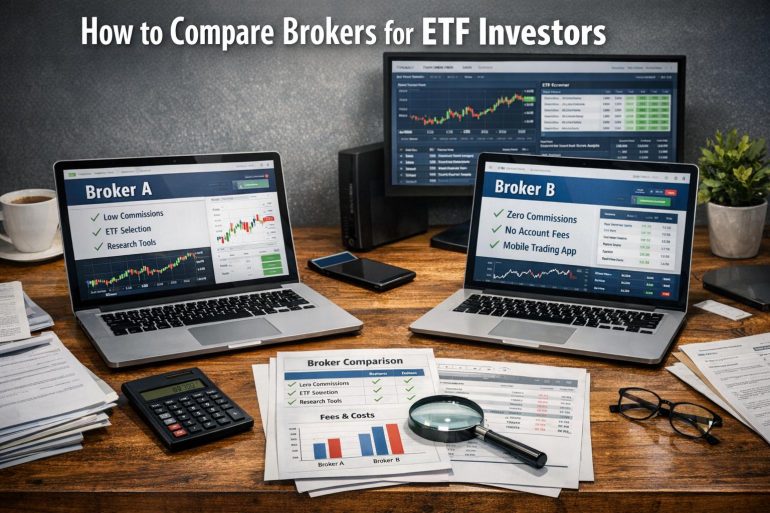
A structured evaluation begins with identifying non-negotiable criteria such as regulatory jurisdiction, ETF universe coverage, retirement account availability, and currency support. Next, investors can model total annual cost using realistic assumptions regarding trade frequency, average order size, and dividend reinvestment.
Testing platform usability through trial accounts allows assessment of reporting clarity and trading workflow. Reviewing regulatory filings and financial disclosures offers additional information about operational stability.
Comparisons should emphasize long-term cost sustainability and reliability rather than introductory incentives or temporary promotions.
Conclusion
Selecting a broker for ETF investing requires systematic assessment of explicit and implicit costs, execution standards, platform resilience, tax reporting quality, regulatory safeguards, and operational transparency. Commission-free marketing claims alone do not determine overall value.
ETF strategies are commonly designed for diversification and compounding across extended time horizons. A brokerage partner that combines transparent pricing, global market access, stable infrastructure, and effective administrative support provides the foundation for consistent portfolio implementation. Through disciplined comparison and periodic review, investors can minimize avoidable friction and maintain structural efficiency in their ETF investment program.
