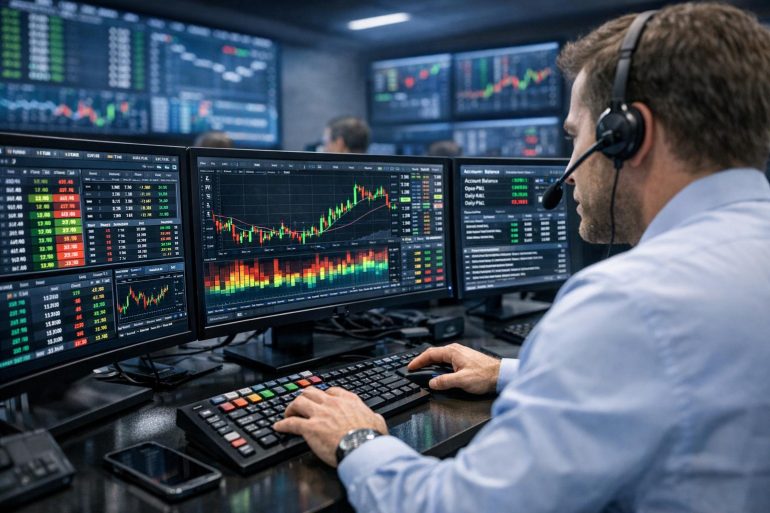
High-frequency trading (HFT) requires infrastructure, market access, and brokerage services that differ significantly from those used by retail or even standard professional traders. The choice of broker plays a central role in determining execution quality, cost efficiency, regulatory compliance, and operational stability. Selecting the right broker for high-frequency trading is therefore a structural decision rather than a simple comparison of commissions.
High-frequency trading strategies rely on speed, automation, and scale. Orders are often generated by algorithms and transmitted to markets within microseconds or milliseconds. In this context, small differences in latency, pricing model, or technological architecture can materially affect performance outcomes. A broker servicing HFT clients must be evaluated against technical, financial, and regulatory criteria.
Unlike discretionary traders who may focus on macroeconomic developments or longer holding periods, high-frequency traders focus on market microstructure. Profitability depends not only on price direction but also on queue dynamics, liquidity provision, and execution placement. For these reasons, broker selection becomes part of the strategy’s quantitative framework rather than an administrative detail.
Understanding the Requirements of High-Frequency Trading
High-frequency trading involves the automated placement of a large number of orders within very short time intervals. Strategies often depend on statistical arbitrage, market making, latency arbitrage, or liquidity detection. Execution quality is typically assessed by microstructure metrics such as queue position, effective spread capture, adverse selection rate, and order fill probability, rather than by long-term directional performance.
Because HFT strategies operate on thin profit margins per trade, transaction costs and latency are critical factors. Even small increases in round-trip execution time can reduce profitability. In highly competitive markets, microsecond advantages may influence order book priority and execution outcomes. As a result, brokers serving high-frequency traders must provide low-latency infrastructure, direct market access (DMA), and stable connectivity to exchanges.
Predictability is as important as speed. A strategy optimized for a specific latency profile may underperform if routing paths fluctuate or if execution timing becomes inconsistent. Therefore, evaluating brokers for HFT requires detailed scrutiny of infrastructure architecture, capacity management, and event handling protocols.
Execution Infrastructure and Latency
The most important factor when selecting a broker for high-frequency trading is execution infrastructure. Latency, measured as the time it takes for an order to travel from the client’s system to the exchange and back, directly affects trading results. Brokers offering colocation services—where trading servers are physically located within or near exchange data centers—are generally preferred by serious HFT participants.
Colocation reduces transmission delays caused by geographic distance. However, location alone is insufficient. Network design, hardware optimization, and routing efficiency also determine overall latency. Dedicated fiber connections, microwave links in certain regional markets, minimized routing hops, and optimized internal switches contribute to reducing delay and jitter.
Consistency is frequently more important than headline speed. If a broker advertises low average latency but exhibits wide variance, order arrival times may become unpredictable. Latency jitter can alter queue positioning, particularly for liquidity-providing strategies that rely on maintaining top-of-book placements.
Order routing structure merits careful examination. Some brokers aggregate liquidity internally or route orders through smart order routers that prioritize best execution across venues. While beneficial for many participants, this layered approach can introduce additional processing time. For HFT strategies, direct market access with minimal intervention is generally preferable. Traders should request detailed information on routing paths, exchange gateways, and whether the broker employs internal matching or principal trading practices.
Network Architecture and Hardware Optimization
Beyond proximity and routing, the broker’s internal hardware environment shapes performance. High-performance network interface cards, kernel bypass technologies, and low-latency operating system configurations contribute to speed and reliability. Some brokers invest in custom FPGA (Field Programmable Gate Array) solutions to accelerate order handling and risk checks. While not all HFT firms require such specialization, understanding the technological stack provides insight into potential bottlenecks.
Capacity planning is equally critical. If a broker services numerous high-volume clients on shared infrastructure without adequate scaling, congestion can occur during peak periods. Traders should inquire about capacity thresholds, historical peak loads, and policies for onboarding additional high-throughput clients.
Another consideration is time synchronization. Precision time stamping, often using GPS or PTP (Precision Time Protocol), ensures accurate event recording and compliance with regulatory reporting standards. Inconsistent time stamps complicate post-trade analysis and transaction cost evaluation.
Order Types and Market Access
High-frequency trading strategies often require advanced order types, including immediate-or-cancel (IOC), fill-or-kill (FOK), pegged orders, hidden orders, midpoint orders, discretionary range orders, and iceberg configurations. The availability and technical consistency of these order types depend on both exchange rules and broker infrastructure.
A broker should provide comprehensive access to venues relevant to the targeted asset class. In equities, this may include primary exchanges, alternative trading systems, and dark pools. In futures and derivatives markets, consistent connectivity to major exchanges is essential for arbitrage and spread strategies. Limited venue access can restrict liquidity sourcing and reduce the scope of statistical modeling.
Support for high message throughput is indispensable. HFT systems generate large numbers of order placements, modifications, and cancellations. Brokers may enforce throttling limits based on exchange requirements or internal risk controls. These thresholds must be understood in advance, along with any tiered pricing adjustments for elevated message ratios.
Commission Structure and Cost Efficiency
Transaction cost control is fundamental because profit margins per trade are typically small. Brokers may offer per-share pricing, per-contract pricing, notional-based commissions, or volume-based tier structures. For active HFT firms, negotiated institutional pricing arrangements are common.
In markets operating under a maker-taker fee model, exchange rebates for liquidity provision materially affect profitability. A broker should pass through rebates transparently and specify any retention applied for routing services. Hidden markups on exchange fees can distort projected returns.
Indirect costs require equal attention. Slippage, execution delay, reject rates, and re-routing events contribute to effective transaction costs. Robust transaction cost analysis (TCA) capabilities, whether provided by the broker or independently generated by the firm, enable objective performance evaluation. The optimal broker is determined not by headline commission alone, but by aggregate net cost under live trading conditions.
Technology Integration and API Access
High-frequency trading depends entirely on automated order generation and execution. Broker-provided APIs must therefore be stable, performant, and precisely documented. Common protocols include FIX, binary exchange gateways, or proprietary low-latency APIs. Each protocol has trade-offs between standardization and performance.
When assessing API quality, traders should examine throughput limits, connection session rules, heartbeat intervals, and message sequencing logic. Error recovery mechanisms are critical. If a session disconnects, automatic reconnection and state reconciliation procedures must prevent order duplication or unintended exposure.
Documentation quality provides insight into operational maturity. Clear specifications for order flags, rejection codes, throttle responses, and maintenance windows reduce implementation risk. Inconsistent or incomplete documentation may lead to unexpected behavior during production deployment.
System Redundancy and Operational Resilience
System outages pose material risk to high-frequency trading operations. Brokers should maintain redundant data centers, backup gateways, and failover pathways. Redundancy should extend not only to hardware but also to network carriers and power supply systems.
Disaster recovery testing is an important consideration. Firms should verify whether the broker conducts regular failover simulations and whether clients are invited to participate. The ability to transition from primary to secondary systems without material latency shifts reduces operational vulnerability.
Operational transparency strengthens confidence. Brokers that provide incident reports and uptime statistics enable informed evaluation. Historical uptime percentages, communication protocols during outages, and average restoration times are objective performance indicators.
Market Data Quality and Speed
Accurate and timely market data feeds are fundamental to high-frequency trading. Delays in receiving price updates may result in stale quoting and increased exposure to adverse selection. Brokers may provide consolidated feeds or direct raw feeds from exchanges.
Depth-of-book data, often referred to as Level II or full order book feeds, is necessary for market-making and liquidity detection strategies. Traders should confirm whether the broker provides native exchange feeds or normalized data streams. Normalization may simplify integration but can introduce marginal latency.
Data integrity is as important as speed. Packet loss, dropped messages, or inconsistent sequencing undermine model reliability. Latency characterization should include both average delay and distribution metrics, as sporadic spikes can materially influence algorithmic decisions.
Risk Management and Margin Policies
All brokers implement risk controls to comply with regulatory obligations and manage counterparty exposure. These include pre-trade risk checks, position limits, and credit exposure monitoring. For high-frequency traders, the architecture of these controls must balance regulatory compliance with latency sensitivity.
Pre-trade checks mandated by regulators may verify order size, price collars, and credit availability before forwarding orders to exchanges. Efficient brokers implement these checks at hardware or near-hardware speed to minimize impact on execution time.
Margin requirements influence capital efficiency. Intraday margin schedules, portfolio margin availability, and cross-asset offsets affect return on capital calculations. Sudden margin adjustments during volatile conditions can force position reductions, thereby altering strategy performance. Understanding the broker’s historical approach to stress events is useful for scenario planning.
Regulatory Environment and Compliance
High-frequency trading operates within a structured regulatory framework in most major markets. Brokers must comply with order recordkeeping, market surveillance, best execution standards, and anti-manipulation regulations. Firms should assess the jurisdiction under which the broker operates and the reputation of the supervising authority.
Operating under established regulators such as the SEC, FCA, or equivalent authorities generally provides institutional credibility and structured oversight. For institutional HFT firms, alignment with a broker that demonstrates consistent compliance reduces the risk of unexpected operational disruption arising from regulatory action.
Some jurisdictions require high-frequency traders to register separately, adhere to order-to-trade ratio limits, or implement enhanced monitoring. Brokers experienced with HFT clients typically incorporate these requirements into their reporting systems, simplifying compliance management for clients.
Financial Stability and Counterparty Risk
Financial stability is often overshadowed by technical considerations, yet it remains essential. High-frequency traders frequently maintain substantial collateral balances to support continuous activity. Evaluating the broker’s capital adequacy, audited financial statements, and segregation of client funds strengthens risk control.
If the broker internalizes trades or operates as principal, counterparty exposure may increase. Transparency regarding trade handling practices and balance sheet strength becomes especially relevant in such arrangements. Participation in investor compensation schemes or clearinghouse memberships may further enhance security.
Creditworthiness, though not a guarantee against failure, provides an additional layer of evaluation. Counterparty assessment should form part of broader enterprise risk management within the trading firm.
Customer Support and Technical Assistance
Despite automation, human support remains necessary. Connectivity disruptions, software updates, or exchange-level issues require prompt resolution. Brokers specializing in algorithmic and institutional clients typically maintain direct technical contacts, including network engineers and API specialists.
Availability during global trading hours is important, especially for firms operating across multiple time zones. Communication channels should include direct telephone access and structured escalation procedures. Delayed or generic support increases the duration of operational interruptions.
Testing Environment and Simulation Tools
Before deploying capital, traders should validate integration within a test environment. A robust simulation or certification gateway enables firms to evaluate order logic, throttling behavior, and error handling without financial exposure.
The realism of the testing environment matters. Accurate replication of exchange matching logic, market data sequencing, and latency characteristics reduces divergence between test and production environments. Structured certification processes also help identify compliance gaps before live deployment.
Scalability and Strategic Flexibility
High-frequency trading operations may expand in volume, asset class coverage, or geographic presence. A broker’s infrastructure should support increased throughput without performance degradation. This includes scalable gateway architecture, adaptable connectivity options, and straightforward onboarding procedures for additional accounts or sub-entities.
Strategic flexibility also involves cross-asset integration. Firms pursuing multi-asset arbitrage benefit from consolidated clearing, risk monitoring, and reporting. Transitioning between brokers after infrastructure expansion can impose operational cost and disruption, making forward-looking selection prudent.
Due Diligence and Quantitative Evaluation
Selecting the right broker requires systematic analysis rather than reliance on promotional claims. Firms should request measurable latency statistics, internal routing diagrams, and detailed fee disclosures. Empirical testing in live or near-live conditions offers the most accurate assessment.
Round-trip latency measurements, message acknowledgment timing, reject frequencies, and uptime history provide quantitative benchmarks. Transaction cost analysis over controlled trading intervals reveals effective cost differences that may not be visible in simplified commission schedules.
Reviewing public disciplinary records, incident reports, and operational disclosures further supports informed evaluation. Decision-making grounded in data aligns broker selection with the quantitative standards typically applied to trading strategy development.
Conclusion
Selecting a broker for high-frequency trading involves comprehensive evaluation of infrastructure, execution pathways, cost structure, market access, regulatory oversight, and financial stability. Speed and consistency form the operational core, yet they must coexist with transparent pricing, strong compliance controls, and scalable architecture.
Because high-frequency trading strategies operate on narrow margins and depend on predictable execution quality, incremental differences between brokers can materially influence long-term results. A structured due diligence process—combining latency testing, cost modeling, regulatory verification, and financial assessment—provides a rational basis for comparison.
The optimal broker for high-frequency trading is characterized by robust low-latency infrastructure, transparent and competitive pricing, sound regulatory standing, and resilient operational systems. Aligning these characteristics with the specific strategic profile of the trading firm ensures that brokerage infrastructure functions as an enabler of performance rather than a structural limitation.
