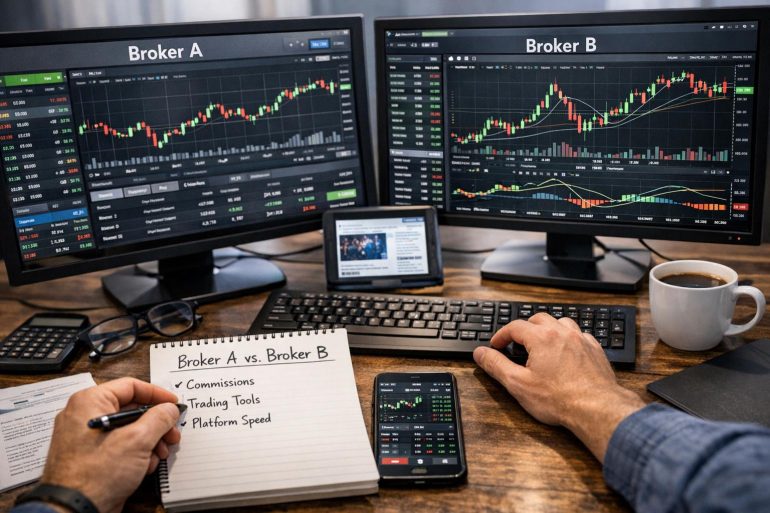
Active traders place a high volume of trades and rely on short- to medium-term price movements to generate returns. Their needs differ significantly from long-term investors who may prioritize buy-and-hold strategies. For active participants, broker selection has a measurable effect on performance, cost efficiency, execution quality, and risk management. Comparing stock brokers requires structured evaluation across trading costs, technology, access to markets, regulatory safeguards, and operational reliability. Each element influences overall trading effectiveness.
Understanding the Needs of Active Traders
Active traders typically execute multiple trades per day, week, or month. Strategies may include day trading, swing trading, momentum trading, scalping, or algorithmic approaches. These strategies depend on timely execution, advanced charting tools, and predictable fee structures. A broker that suits a casual investor may not meet the demands of someone operating with speed-sensitive entry and exit points.
Trade duration is often short, and capital turnover is high. Because of this, small inefficiencies in pricing, delays in execution, or platform malfunctions can compound over dozens or hundreds of transactions. An investor who rebalances a portfolio quarterly may not notice a minor execution delay, but an intraday trader responding to a volatility spike may experience direct financial impact.
Before comparing brokers, traders should define their own priorities. A high-frequency equities trader may value direct market access and low latency, while an options trader may focus on contract fees and advanced risk analytics. Futures or leveraged product traders may prioritize margin policies and overnight financing rates. Mapping strategy requirements to broker capabilities provides a structured starting point for evaluation.
Commission Structures and Trading Costs
Trading costs are central to broker comparison. While many brokers advertise commission-free trading for certain products, the overall cost structure often extends beyond headline commissions. Active traders should examine all direct and indirect charges with attention to detail.
Per-trade commissions remain relevant, especially for options, futures, and international securities. Even where equity commissions are nominally zero, per-contract fees on derivatives can materially affect total monthly expense. Brokers frequently implement tiered pricing schedules that reduce costs once specified volume thresholds are reached. Traders should calculate projected monthly share volume or contract counts to determine where they fall within these tiers.
Spread-related costs must also be considered. The difference between the bid and ask price effectively represents a transaction cost. Brokers that receive payment for order flow may route trades to specific market makers. While this practice can reduce or eliminate explicit commissions, traders should analyze execution price relative to the national best bid and offer. If price improvement statistics are strong and consistent, routing arrangements may not introduce measurable disadvantage. Independent execution quality disclosures can provide clarity.
Margin interest rates are another significant component for leveraged traders. Rates may vary based on account size and benchmark interest levels. A broker quoting competitive base rates but applying higher spreads over the benchmark can result in higher borrowing costs. Traders who maintain overnight leveraged positions or who actively rotate capital through margin accounts should simulate annualized interest expense under realistic conditions.
Additional charges may include exchange fees, regulatory transaction fees, options assignment or exercise fees, stock borrow costs for short positions, wire transfer charges, and inactivity fees. While each may appear modest individually, the aggregate effect becomes relevant in high-frequency contexts. Careful review of the broker’s comprehensive fee schedule is necessary to avoid unforeseen deductions from trading capital.
For those trading international securities, foreign exchange spreads and conversion charges introduce further cost variables. Some brokers offer multicurrency accounts that allow balances to be held in different denominations, reducing repetitive conversions. Others automatically convert at each transaction, increasing total expense over time.
Execution Quality and Order Routing
Execution quality directly affects realized trade outcomes. For active traders, small price discrepancies across numerous trades influence overall profitability. Speed of execution, likelihood of partial fills, slippage frequency, and routing transparency are all relevant metrics.
In many jurisdictions, brokers publish periodic execution quality reports detailing statistics such as average execution speed, percentage of orders receiving price improvement, and distribution of routed venues. Reviewing these reports provides an empirical basis for comparison rather than relying on marketing claims.
Direct market access (DMA) brokers allow traders to route orders straight to specific exchanges or electronic communication networks (ECNs). This arrangement can enhance transparency and give traders control over routing decisions. It may also enable participation in displayed liquidity or hidden order types that are not accessible through fully internalized models.
Conversely, brokers that internalize order flow may provide consistent fills with minimal visible routing complexity. The practical difference often depends on trade size, liquidity conditions, and order type. Traders executing large orders relative to average daily volume may benefit from brokers that support smart order routing algorithms designed to minimize market impact.
Order type availability deserves close inspection. Active traders often rely on conditional instructions such as stop-limit orders, trailing stops, bracket orders that combine entry and exit targets, and one-cancels-the-other structures. The absence of advanced order controls can force manual intervention, increasing operational risk during volatile periods.
Trading Platform and Technology
The trading platform functions as the operational hub for strategy implementation. Interface speed, customization capacity, and data presentation all affect efficiency. Delays caused by unstable software or poorly optimized systems can disrupt execution timing.
Comprehensive charting tools are fundamental. Platforms should support multiple time frames, a range of technical indicators, and drawing capabilities. The ability to detach charts onto multiple monitors and save layout templates contributes to workflow consistency. Traders who analyze multiple instruments simultaneously require rapid switching between watchlists and chart views without latency.
System stability during periods of high market volume is a key differentiator. Historical reliability data, including records of outages during major market events, can indicate infrastructure robustness. Even brief downtime during fast-moving sessions may limit a trader’s capacity to respond to risk.
Algorithmic traders require well-documented application programming interfaces (APIs). These interfaces should permit market data retrieval, order submission, modification, and cancellation. Latency metrics, rate limits, and authentication protocols are critical technical parameters. Brokers differ in whether API access is free or tied to minimum balance or subscription requirements.
Mobile applications serve as supplementary tools for monitoring and order management. While most detailed analysis occurs on desktop systems, reliable mobile execution capability offers continuity when accessing markets remotely.
Market Access and Product Range
Asset class coverage determines strategic flexibility. Many active traders diversify across equities, exchange-traded funds, options, futures, and occasionally foreign exchange products. A broker offering integrated access to multiple asset classes simplifies cross-product strategies.
Domestic equity access should include major exchanges as well as alternative trading venues. For traders seeking geographic diversification, availability of foreign exchanges is important. Access may be provided directly, through local market memberships, or through omnibus arrangements with international partners.
Options trading features merit careful evaluation. An advanced options trader typically requires multi-leg order entry, complex spread functionality, risk graphs, implied volatility analytics, and scenario analysis tools. Contract fees, exchange routing costs, and exercise policies also influence broker suitability.
Futures and other derivatives introduce additional complexity. Contract specifications, intraday margin allowances, and overnight financing terms can vary. Traders should verify that margin treatment aligns with their strategy’s holding period and volatility exposure.
Regulatory differences across jurisdictions may restrict product availability. Traders must confirm that the broker is authorized to offer specific instruments within their country of residence to ensure compliance with local rules.
Margin Requirements and Risk Controls
Margin policies affect capital efficiency and risk exposure. Regulatory authorities typically set baseline margin requirements, but brokers may impose stricter “house” standards. These additional requirements often increase during periods of elevated volatility.
Active traders should compare initial and maintenance margin thresholds across brokers. Some firms offer portfolio margin accounts, which calculate requirements based on overall portfolio risk rather than fixed percentages. Portfolio margin can reduce capital requirements for hedged strategies but increases complexity.
Real-time risk monitoring tools are essential. Platforms that display continuously updated margin usage, buying power, and liquidation thresholds allow traders to manage exposure proactively. Automated alerts when approaching maintenance limits can prevent forced liquidation.
Short-selling availability varies significantly. Brokers maintain securities lending inventories, and borrow rates fluctuate based on demand and supply. Traders engaged in frequent short activity should review historical availability data and borrowing cost structures.
Data Feeds and Research Tools
Market data accuracy and speed underpin decision-making. Active traders often subscribe to enhanced feeds beyond basic quotes. Level II data displaying order book depth, time-and-sales records showing transaction flow, and real-time news integration provide additional context for price movement.
Latency in data delivery can hinder quick decision-making. Traders should evaluate whether data feeds are consolidated or sourced directly from exchanges. Historical data accessibility, including intraday time series, supports strategy testing and performance analysis.
Even predominantly technical traders benefit from awareness of scheduled economic releases, earnings announcements, and corporate actions. Integrated research calendars within the trading platform reduce the need for external tracking tools.
Regulation and Account Protection
Regulatory oversight establishes operational standards and customer protection mechanisms. Traders should confirm registration with recognized financial authorities and review the broker’s disciplinary history where accessible.
Client asset segregation is a fundamental safeguard. Brokers are typically required to separate customer funds from corporate assets. Investor compensation schemes, where applicable, offer limited protection in cases of firm insolvency. Coverage limits vary by jurisdiction.
Publicly traded brokerage firms publish audited financial statements that provide visibility into capital adequacy and risk management frameworks. Privately held firms may disclose less information, making regulatory compliance records especially important for evaluation.
Customer Support and Operational Efficiency
Operational responsiveness affects ongoing trading continuity. Access to knowledgeable support representatives during market hours can be important when resolving execution disputes or technical irregularities.
Funding procedures should be reviewed, including deposit methods, settlement timelines, and withdrawal processing speed. Traders who move capital between accounts or respond to new opportunities benefit from streamlined transfer capability.
Account statements, trade confirmations, and tax reporting documentation should be clear and easily retrievable. Efficient recordkeeping reduces administrative overhead and supports compliance obligations.
Platform Fees, Subscriptions, and Hidden Charges
Advanced platforms may carry subscription charges. In some cases, fees are offset once trading volume exceeds minimum thresholds. Traders should perform cost comparisons under realistic activity assumptions rather than assuming volume discounts automatically apply.
Market data packages often involve separate exchange fees. Professional designation status, as defined by exchanges, may increase monthly data costs. Understanding classification criteria prevents billing surprises.
Transparent fee disclosure is a sign of operational clarity. Reviewing official documents rather than promotional materials helps identify non-obvious charges embedded within account agreements.
Educational Resources and Development Tools
Continuous refinement of strategy requires access to reliable information. Brokers that provide detailed platform tutorials, structured webinars, and analytical documentation can accelerate familiarity with advanced features.
Simulated trading environments allow testing of new systems without financial exposure. For algorithmic traders, paper trading connected to live market data allows validation of execution logic under real-time conditions while avoiding capital risk.
Comparing Brokers Systematically
A systematic comparison begins with identifying quantifiable metrics. Estimating projected monthly trade counts, average trade size, margin usage, and product mix provides inputs for calculating total expected cost.
Traders may construct comparison tables that incorporate commission schedules, margin rates, platform fees, and data subscription costs. Including estimated slippage assumptions based on published execution data creates a more comprehensive projection.
Testing platform functionality through demo accounts or limited initial deposits provides direct observation of execution speed and interface usability. Practical testing complements document-based evaluation.
Balancing Cost and Infrastructure Quality
Minimizing explicit commissions does not guarantee optimal outcomes. Reliable infrastructure, robust cybersecurity protocols, and strong balance sheet stability contribute to consistent operations. A broker offering slightly higher trading fees but superior execution performance may deliver improved net results over time.
Infrastructure investment often distinguishes established firms from smaller competitors. Evaluating capital resources, technology partnerships, and historical service continuity supports informed trade-offs between pricing and stability.
International Considerations
Cross-border trading introduces tax reporting complexity and currency management considerations. Brokers that provide transaction export tools compatible with accounting software simplify compliance processes.
Clear policies regarding dividend withholding tax, foreign transaction levies, and cross-border settlement timelines reduce ambiguity. Traders operating in multiple regions benefit from brokers offering integrated global account management.
Reviewing Reputation and Industry Standing
Longevity and disciplinary history provide context for assessing reliability. Regulatory enforcement records, capital adequacy disclosures, and documented operational disruptions inform due diligence.
Customer feedback, while subjective, can reveal recurring issues related to system outages or withdrawal delays. Consistent patterns deserve attention, particularly when aligned with publicly verifiable incidents.
Final Evaluation Framework
Comparing stock brokers for active trading requires multidimensional assessment. Trading costs, execution quality, platform performance, market access, margin treatment, regulatory safeguards, and operational resilience collectively determine suitability.
No broker uniformly leads across all categories. Strategy characteristics, asset class focus, and trading intensity define which attributes carry the greatest weight. By quantifying expected usage patterns, reviewing verified disclosures, and conducting practical tests, traders can build an evidence-based comparison.
Active trading inherently involves exposure to market volatility and liquidity fluctuations. Broker selection does not remove these risks, but it shapes the efficiency and structural reliability of trade implementation. A structured evaluation process aligns brokerage infrastructure with strategic objectives, supporting disciplined participation in financial markets.
