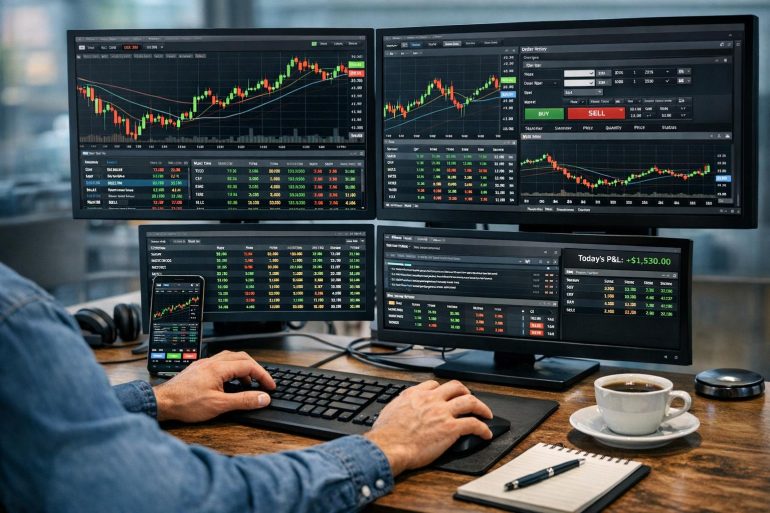
Day trading brokers provide the market access, execution systems, and financial infrastructure required for short-term traders to buy and sell financial instruments within the same trading session. Unlike long-term investing, day trading depends on speed, precision, low transaction costs, and reliable technology. The choice of broker plays a central role in determining whether a trader can efficiently implement a short-term strategy. This article explains how day trading brokers operate, the features that matter most, regulatory considerations, and the structural differences between broker types.
Understanding the Role of Day Trading Brokers
A day trading broker acts as an intermediary between the trader and financial markets such as equity exchanges, futures exchanges, foreign exchange markets, and cryptocurrency platforms. While long-term investors may prioritize research tools and retirement account options, day traders focus primarily on execution quality, transaction cost efficiency, and platform stability.
Day trading involves frequent transactions, often executed within minutes or seconds. Because profits per trade are typically small relative to position size, traders rely on rapid order fulfillment and predictable costs. A broker’s order routing system, server uptime, and liquidity access therefore directly affect potential returns. Even slight slippage between expected and actual execution prices can accumulate over dozens or hundreds of trades within a session.
Most modern brokers operate through electronic trading systems. Traders access markets via proprietary software platforms or third-party systems, placing market, limit, stop, stop-limit, trailing stop, and conditional orders. These platforms connect to routing networks that execute orders either on public exchanges, through electronic communication networks (ECNs), or via internal liquidity pools maintained by the broker or affiliated market makers.
In addition to order handling, brokers provide clearing and settlement services. After a trade is executed, the broker ensures proper recording, margin calculation, and regulatory reporting. Clearing arrangements may be handled internally or through third-party clearing firms. For day traders, back-end processing may appear invisible, but it remains essential to accurate account balances and risk controls.
Key Characteristics of a Day Trading Broker
Execution Speed and Reliability
Fast execution is fundamental for day traders. In highly liquid instruments such as large-cap equities or major currency pairs, prices can change multiple times per second. A delay measured in milliseconds may not appear substantial in isolation, but for strategies that rely on precise entry and exit levels, consistent latency affects strategy performance.
Brokers often publish execution reports detailing average speed, fill ratio, and percentage of orders receiving price improvement. These statistics should be interpreted carefully, as reporting methodologies differ. Traders who require high precision frequently examine infrastructure details such as co-location arrangements with exchange data centers, fiber-optic routing paths, and internal order matching logic.
Low latency infrastructure generally includes colocated servers near exchange gateways, optimized hardware, and high-capacity network connections. Redundant systems, including backup data centers and failover protocols, help maintain operational continuity during periods of heavy trading activity or unexpected hardware events.
Commission Structure and Fees
Because day traders place numerous trades, cost structure has direct implications for net performance. Brokers apply distinct pricing models depending on asset class and business model.
Per-share or per-contract pricing charges a fixed rate for each share traded or each futures contract executed. This model is common among direct market access equity brokers and futures brokers. High-volume traders may negotiate tiered pricing based on monthly activity.
Spread-based pricing is typical in foreign exchange and contracts-for-difference markets. Instead of a separate commission line item, the broker incorporates compensation within the difference between bid and ask prices. Narrower spreads reduce effective trading cost but may vary according to market conditions.
Commission-free models in equity markets are often supported through payment for order flow arrangements or internalized execution. While advertised commissions may be zero, traders should still consider implicit costs such as spread width and execution quality.
Beyond standard commissions, traders may incur exchange connectivity fees, data subscription costs for advanced depth-of-book feeds, margin interest charges, and inactivity fees. Additionally, certain brokers charge routing fees when using specific ECNs. Evaluating the complete schedule of charges allows a more accurate estimate of effective trading cost.
Margin and Leverage
Many day traders operate margin accounts to increase purchasing power. Margin allows the trader to control a larger position value relative to account equity. Regulatory frameworks differ by jurisdiction. In the United States, a trader who executes four or more day trades within five business days may be classified as a pattern day trader and must maintain a minimum equity level.
Brokers may extend higher leverage for intraday positions than for overnight holdings. This approach limits exposure outside regular market hours when liquidity may decline. Margin rates, maintenance thresholds, and liquidation procedures should be clearly defined in account documentation.
Leverage increases both upside and downside potential. To manage risk, brokers deploy automated monitoring systems that calculate real-time equity and margin utilization. If account equity falls below maintenance levels, the risk system may restrict new orders or liquidate positions without prior notice to restore compliance.
Trading Platforms and Analytical Tools
Day trading requires continuous monitoring of price action. Most brokers provide real-time streaming data and charting interfaces with adjustable time intervals, ranging from tick-level charts to multi-day aggregations. Technical indicators such as moving averages, volume-weighted average price (VWAP), Bollinger Bands, and oscillators are commonly included.
Advanced platforms incorporate Level II market depth displays, showing aggregated bid and ask orders at multiple price levels. Time-and-sales windows record executed transactions, enabling traders to observe trade flow. Conditional orders, including bracket orders that simultaneously define profit targets and stop losses, facilitate structured risk control.
Hotkey functionality enables rapid order entry without navigating multiple menus. Some brokers integrate scripting languages or APIs, allowing automated strategies through algorithmic trading. Backtesting modules permit simulation of historical performance using past data, though results depend on data accuracy and modeling assumptions.
Platform reliability during volatile periods remains critical. High traffic volumes during economic announcements, corporate earnings releases, or geopolitical developments can strain infrastructure. Brokers invest in scalable server architecture and monitoring systems to mitigate performance degradation.
Types of Day Trading Brokers
Direct Market Access (DMA) Brokers
Direct market access brokers provide traders with the ability to route orders directly to specified exchanges or ECNs. Instead of sending all orders to a centralized internal system, traders can select destinations based on liquidity, rebate opportunities, or execution speed.
DMA brokers typically employ transparent per-share pricing models and pass through exchange fees and rebates. Active equity traders who implement liquidity-providing strategies may use routing choices to capture exchange rebates, offsetting trading costs. This structure requires understanding of market microstructure and exchange fee schedules.
Online Retail Brokers
Mainstream retail brokers offer simplified access to equities, options, and exchange-traded products. Interfaces are designed for usability, often integrating linked bank accounts, research reports, and portfolio analytics. Commission-free equity trading has expanded retail participation in short-term strategies.
Order routing decisions at retail brokerages may be automated and not directly modifiable by the client. In certain cases, high-frequency or latency-sensitive strategies may be restricted under the broker’s user agreement. Retail brokers generally prioritize ease of use and regulatory compliance over granular routing control.
Futures Brokers
Futures brokers connect traders to derivatives exchanges where standardized contracts represent commodities, equity indices, interest rates, or currencies. Because futures markets are centrally cleared and typically operate nearly around the clock during the trading week, day traders may access extended trading sessions.
Margin requirements in futures markets are performance-based and adjusted according to volatility conditions set by exchanges and clearinghouses. Intraday margin concessions may reduce required capital during regular hours, though positions held beyond session close must meet overnight requirements.
Forex Brokers
Foreign exchange brokers provide access to the global currency market, which primarily operates over the counter. Execution models vary. Market-maker brokers internalize order flow, quoting bid and ask prices directly. ECN brokers aggregate liquidity from banks and institutional counterparties, offering variable spreads and separate commissions.
Because forex trading lacks a single centralized exchange, evaluating regulatory status and execution transparency is essential. Traders review average spread data, slippage statistics, and trade execution disclosures when comparing providers.
Regulation and Compliance
Regulatory Bodies
Day trading brokers operate under jurisdiction-specific regulatory authorities. In the United States, the Securities and Exchange Commission (SEC) oversees securities markets, while the Financial Industry Regulatory Authority (FINRA) supervises broker-dealers. Futures brokers are regulated by the Commodity Futures Trading Commission (CFTC) and monitored by the National Futures Association (NFA).
Within the United Kingdom, oversight is conducted by the Financial Conduct Authority (FCA). Across the European Union, national regulators coordinate under the framework established by the European Securities and Markets Authority (ESMA). Comparable regulatory agencies exist in Canada, Australia, Singapore, and other financial centers.
Capital Requirements and Client Safeguards
Regulated brokers must satisfy minimum capital standards designed to ensure solvency under stressed market conditions. Client funds are typically held in segregated accounts separate from the broker’s operational assets. In some jurisdictions, investor compensation schemes provide limited coverage if a broker becomes insolvent.
Compliance departments monitor anti-money laundering requirements, know-your-customer procedures, transaction reporting, and best execution obligations. Traders can verify registration status and disciplinary history through official regulatory databases.
Order Routing and Payment for Order Flow
Order routing influences execution outcomes. Payment for order flow refers to the practice of receiving compensation from market makers in exchange for directing client orders to specific venues. Supporters argue that this arrangement supports zero-commission trading and may produce price improvement relative to quoted spreads.
Critics note potential conflicts of interest if routing decisions prioritize broker compensation over optimal execution. Regulatory frameworks increasingly mandate detailed disclosure of routing practices and execution quality metrics. Traders who require explicit venue control may select brokers offering direct routing options instead of automated internalization.
Risk Management and Technology Infrastructure
Risk management systems operate continuously behind the trading interface. Real-time engines calculate exposure across asset classes, evaluate unrealized profit and loss, and apply margin algorithms. Automated controls may block orders that exceed pre-defined limits or breach regulatory constraints.
Cybersecurity protocols protect client information through encryption, multi-factor authentication, and intrusion detection systems. Data centers incorporate physical security controls and environmental safeguards. Redundancy planning includes backup power supplies and geographically dispersed facilities to reduce systemic vulnerability.
Market Access Beyond Equities
Many day traders diversify trading activity across asset categories. Brokers may provide unified access to exchange-traded funds, listed options, index futures, micro contracts, corporate bonds, and cryptocurrency derivatives. Multi-asset platforms consolidate reporting and facilitate capital allocation between instruments.
However, each asset class introduces distinct settlement cycles, contract specifications, and margin methodologies. Options trading involves time decay and implied volatility considerations, while futures contracts may require rollover before expiration. Brokers supply contract specifications and educational materials to clarify these structural differences.
Tax Considerations
Tax treatment depends on jurisdiction and instrument type. Short-term capital gains from equity trades may be taxed at different rates than long-term holdings. Certain futures contracts receive blended tax treatment under specific regulatory codes. Foreign exchange gains may be categorized differently depending on election status or transactional structure.
Brokers issue periodic account statements summarizing realized and unrealized gains, transaction costs, and dividends. Nevertheless, traders bear responsibility for compliance with local tax laws. Maintaining organized records of trade confirmations, expense reports, and margin interest payments supports accurate reporting.
In some regions, qualification as a professional trader or business entity may alter deductibility of expenses or income classification. Requirements for such status typically include frequency thresholds, capital dedication, and demonstrable intent to operate as a trading enterprise.
Evaluating Broker Suitability
Aligning strategy requirements with broker capabilities involves both quantitative and operational assessment. Traders often test execution through simulated accounts before deploying capital. Reviewing detailed fee schedules, comparing historical execution statistics, and analyzing publicly available financial statements contribute to informed selection.
Customer service responsiveness also influences suitability. Technical or account-related issues during market hours require efficient resolution channels. Availability of phone, chat, or dedicated account representatives may vary depending on account size or subscription tier.
Institutional and Retail Contexts
Institutional day trading firms operate under distinct structural conditions. Proprietary trading firms may maintain exchange memberships, granting direct connectivity and lower transaction fees. Traders within such firms often trade firm capital under risk limits and performance targets.
Retail traders operate independently through brokerage accounts governed by standardized agreements. Leverage allowances and risk parameters are stricter. While retail participants typically face higher per-unit transaction costs relative to institutions, technological access has narrowed historical disparities in platform capability.
Emerging Developments in Brokerage Services
Technological changes continue to influence brokerage models. Algorithmic trading APIs support systematic execution strategies built in programming languages such as Python or C++. Cloud-based deployment reduces dependence on personal hardware and enables remote server hosting in proximity to exchange infrastructure.
Artificial intelligence tools analyze historical order flow for optimization insights. Enhanced visualization modules transform real-time data into structured dashboards. Regulatory developments also shape market structure, particularly concerning transparency in order routing and capital reporting obligations.
Conclusion
Day trading brokers form the operational foundation of short-term market participation. Core evaluation criteria include execution consistency, cost transparency, regulatory oversight, margin policy clarity, and technological resilience. Differences among direct market access brokers, retail brokers, futures specialists, and forex providers influence how orders are processed and how fees are incurred.
Because day trading strategies depend on narrow margins and precise timing, brokerage selection represents a structural component of overall trading performance. Careful examination of infrastructure, disclosure practices, and risk controls reduces operational uncertainty. While strategic decisions remain the responsibility of the trader, the broker determines the efficiency and reliability of access to financial markets.
A structured and analytical approach to comparing brokerage services allows traders to align operational capabilities with specific methodologies. Understanding these institutional mechanics supports informed participation in fast-moving and technologically complex market environments.