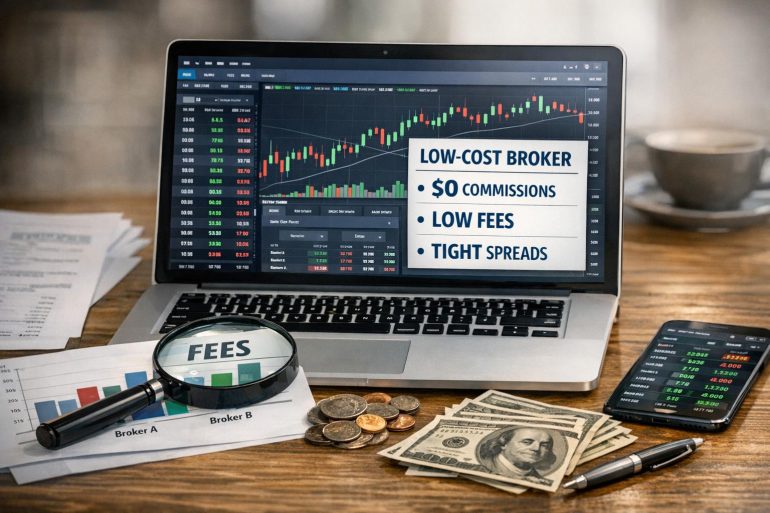
Finding a broker with the lowest trading costs requires careful examination of how brokerage firms structure their pricing. Trading costs are not limited to visible commissions. They also include spreads, account maintenance fees, financing charges, and a range of indirect expenses that can significantly affect long-term returns. A methodical approach to comparing brokers helps traders reduce unnecessary costs and preserve capital over time. Cost control is not merely a short-term concern; over years of investing or active trading, small differences in fees can compound into meaningful variations in portfolio performance.
Understanding the Components of Trading Costs
Before comparing brokers, it is essential to understand the full structure of trading expenses. Many investors focus only on commissions, but the actual cost of trading often involves multiple elements working together. These components can vary depending on the asset class, account type, geographic location, and the trading strategy employed.
Commissions remain the most recognized expense. Some brokers charge a flat fee per trade regardless of trade size, while others assess a percentage of the transaction value. In equity markets, commission-free trading has become common, particularly for retail clients. However, commission-free structures are often supported by alternative revenue sources, meaning traders must evaluate the broader pricing model rather than assuming zero explicit commission equates to zero cost.
Spreads represent another key expense. The spread is the difference between the bid price, which reflects what buyers are willing to pay, and the ask price, which represents what sellers demand. When traders place market orders, they typically transact at the ask when buying and at the bid when selling, effectively paying the spread. Even a small difference in quoted spread can materially affect high-frequency or short-term trading strategies.
Financing charges apply to leveraged positions. When trading on margin, investors borrow funds from the broker and incur interest charges. These costs accumulate daily and can exceed initial expectations if positions are held for extended periods. Margin rates differ significantly between brokers, often based on account size and overall borrowing levels.
Account fees may include inactivity charges, minimum balance fees, custodial fees for retirement accounts, platform subscription costs, and withdrawal or wire fees. Some brokers waive these expenses if specific conditions are met, such as maintaining a minimum balance or executing a certain number of trades.
For derivatives like options and futures, traders must consider per-contract commissions and exchange fees. In addition, market data fees can be substantial, particularly for professional traders who require real-time Level II data or access to multiple exchanges.
Direct and Indirect Trading Costs
Trading expenses can be divided into direct and indirect categories. Direct costs include explicitly stated commissions and subscription fees. Indirect costs are less transparent but can be equally significant. These may arise from order execution quality, market impact, and currency conversion practices.
Market impact refers to the price movement caused by executing a trade. Larger orders, particularly in thinly traded securities, can move the market against the trader. Although not technically a broker fee, the quality of order routing and liquidity access may influence this cost. Brokers with access to deep liquidity pools or smart order routing systems can reduce adverse price movements.
Currency conversion costs present another indirect expense. When trading securities denominated in foreign currencies, brokers typically apply a conversion spread above the interbank rate. Even small conversion margins can accumulate when capital is moved frequently across currencies.
Other indirect costs include opportunity costs caused by platform outages, delayed execution, or limited order functionality. These operational limitations may prevent traders from implementing strategies efficiently.
Evaluating Commission Structures
The structure of commission pricing affects overall cost efficiency. Some brokers use a per-share model, charging a small fee for each share traded. This model may benefit traders dealing in low-priced securities but could be less advantageous for high-priced assets. Alternatively, flat-rate commissions offer predictability but may be less efficient for very small trades.
Commission-free brokers frequently generate revenue through payment for order flow. In this arrangement, orders are routed to specific market makers who compensate the broker. While this model can reduce explicit trading fees, traders should examine execution statistics to determine whether price improvement offsets potential spread widening.
Tiered commission schedules are relevant for active participants. Brokers may reduce per-trade or per-share costs once monthly trading volume surpasses predefined thresholds. Understanding personal trading frequency is essential when evaluating these incentive structures.
Asset-specific commission policies also require review. A broker may eliminate commissions on stocks but maintain standard pricing for options, bonds, or international equities. Traders operating across multiple asset classes must analyze the blended cost structure rather than focusing solely on a single product.
The Importance of Spread and Execution Quality
Spread represents a critical yet often underestimated cost. Brokers operating as market makers may control quoted spreads internally, while agency brokers route orders directly to exchanges. Wider spreads increase transaction costs, particularly for short-term traders who enter and exit positions frequently.
Execution quality influences effective trading expenses. Fast and accurate order routing reduces the likelihood of slippage, defined as the difference between the expected execution price and the final executed price. Slippage becomes more prominent in volatile markets or with large order sizes.
Many regulators require brokers to publish execution quality reports. These documents may include metrics such as average execution speed, percentage of price improvement, and order fill rates. Reviewing these reports allows traders to assess whether advertised low commissions are offset by weaker execution performance.
Limit orders can help control spread-related costs, but they may not guarantee execution. Evaluating how a broker handles limit order prioritization and routing can provide additional insight into potential hidden expenses.
Comparing Margin Rates and Financing Fees
Margin trading increases both potential returns and associated costs. Brokers charge interest on borrowed capital, often calculated daily and applied monthly. Even a one- or two-percentage-point difference in annualized margin rates can generate substantial cost variation for leveraged accounts.
Some brokers use a tiered margin rate system where higher borrowing levels qualify for lower rates. Traders should calculate anticipated borrowing amounts and compare total projected interest across providers. It is also important to assess how frequently interest rates adjust in response to benchmark changes.
Futures, forex, and CFD traders encounter additional financing elements. Overnight holding costs, often referred to as swap rates or rollover fees, may fluctuate depending on interest rate differentials and broker markups. Understanding how these fees are computed contributes to more accurate long-term cost projections.
Reviewing maintenance margin requirements is equally relevant. Higher maintenance thresholds may increase the probability of margin calls, potentially forcing liquidation at unfavorable prices. While not a fee in itself, such policy differences can create cost-related consequences.
Assessing Platform Fees and Data Costs
Technology access represents another layer of pricing. Basic web-based platforms are often provided at no additional charge. However, advanced features such as algorithmic trading interfaces, direct market access systems, or integrated analytics tools may involve subscriptions.
Professional traders commonly require real-time data feeds from multiple exchanges. Exchanges may classify users as professional or non-professional, applying different fee schedules accordingly. These data charges are usually passed through by the broker to the client.
Evaluate whether platform subscriptions are optional or mandatory. Some brokers waive platform fees if monthly commission thresholds are met. Others bundle advanced tools into premium account tiers with associated costs. Aligning platform capabilities with actual trading requirements prevents unnecessary expenditures.
Account Minimums and Administrative Charges
While not strictly trading fees, account minimums influence capital flexibility. Brokers with high minimum deposit requirements may limit diversification opportunities if significant funds must remain unused to satisfy eligibility criteria.
Administrative costs may include account transfer fees, annual IRA custodial fees, statement delivery charges, and wire withdrawal fees. Investors transferring accounts between brokers should account for outgoing transfer charges, which may be charged per asset or as a flat processing fee.
Currency conversion markups deserve particular attention for internationally diversified portfolios. Some brokers allow clients to hold multi-currency balances, reducing repeated conversion costs. Others automatically convert foreign proceeds back into the base currency, potentially generating recurring hidden spreads.
Evaluating Asset Coverage and Product Suitability
Cost comparisons should align with intended trading instruments. A broker optimized for low-cost equity trading may not provide competitive pricing for fixed income products or structured instruments. Bond trading, for example, can involve markups embedded in pricing rather than explicit commissions.
Options traders should analyze per-contract fees, assignment fees, and exercise charges. Strategies involving high contract turnover may amplify these expenses. Futures traders must consider exchange fees, clearing fees, and regulatory assessments in addition to broker commissions.
Access to international markets introduces additional considerations. Custody fees for foreign securities, stamp duties in certain jurisdictions, and cross-border settlement charges may apply. Comprehensive cost assessment includes these jurisdiction-specific elements.
Regulation and Financial Stability
Although minimizing trading costs is important, broker reliability remains a priority. Regulatory oversight helps ensure transparency, capital adequacy, and segregation of client funds. Confirming that a broker operates under a recognized financial authority provides assurance regarding compliance standards.
Investor protection schemes vary by country. In the United States, SIPC coverage protects client securities up to statutory limits in the event of broker insolvency. Other jurisdictions maintain parallel compensation frameworks. Understanding the scope and limits of these programs informs risk management decisions.
Financial stability reduces counterparty risk, especially for large balances or derivative exposure. Reviewing publicly available financial statements or parent company disclosures can provide insight into institutional strength.
Using Comparison Tools and Structured Methodology
A systematic comparison process improves accuracy. Traders can begin by outlining expected annual trade volume, average trade size, asset classes used, and anticipated leverage. With this information, projected commission totals, margin interest expenses, and subscription charges can be estimated across multiple brokers.
Independent broker comparisons published by financial research firms may offer structured summaries of pricing policies. However, traders should verify findings directly through official fee disclosure documents. Regulatory filings and standardized pricing schedules provide the most reliable data.
Cost calculators can assist in modeling hypothetical scenarios. By adjusting variables such as trade frequency and leverage levels, traders can approximate long-term financial impact under different brokerage arrangements.
Balancing Cost With Service Quality
Service quality influences overall trading efficiency. Customer support responsiveness becomes particularly relevant during corporate actions, margin calls, or technical disruptions. Delays in assistance may indirectly generate financial losses.
Platform stability and server reliability are operational considerations. During periods of market stress, high system uptime reduces the likelihood of execution delays. Evaluating a broker’s record during volatile market conditions may provide useful insight.
Order functionality also affects strategy implementation. Advanced order types such as conditional triggers, bracket orders, and algorithmic routing may justify marginally higher commission costs if they enhance execution control.
Tax Efficiency and Reporting Tools
Accurate reporting tools support cost control by simplifying compliance. Brokers that generate detailed transaction histories, realized gain summaries, and downloadable tax documents reduce administrative burdens.
Some platforms include integrated performance analytics or tax-optimization tools. Although not direct cost reductions, these features may help investors manage capital gains timing and portfolio allocation more efficiently.
For international investors, correct handling of withholding taxes and treaty benefits can prevent overpayment. Brokers offering automated documentation processing may indirectly enhance after-tax returns.
Testing the Platform Before Committing Capital
Many brokers offer demonstration accounts that simulate real market conditions. Testing order entry processes, charting tools, and reporting interfaces enables users to determine whether platform functionality aligns with trading requirements.
Opening a small funded account can provide further evidence of execution consistency. Observing effective spreads and order fill prices over time contributes to a more accurate assessment of real-world trading costs.
Negotiating Fees for Larger Accounts
Investors with substantial capital or high trading volume may qualify for customized pricing. Brokers competing for larger accounts sometimes reduce commissions, narrow margin spreads, or waive platform fees. Institutional-style pricing discussions typically occur directly with dedicated account representatives.
Documenting competing offers can strengthen a negotiation position. While not all brokers negotiate advertised rates, certain firms maintain flexibility for well-capitalized or professional clients.
Long-Term Cost Considerations
Over extended time horizons, incremental cost differences compound. A small annual percentage increase in recurring account expenses can result in measurable long-term portfolio divergence. Active traders may accumulate thousands of individual transactions annually, amplifying the impact of per-trade differences.
Total cost analysis integrates explicit commissions, spread impact estimates, financing charges, subscription fees, and anticipated administrative costs. This approach produces a comprehensive comparison rather than a narrow focus on headline pricing.
Periodic reassessment is advisable. Brokerage competition and regulatory changes frequently reshape pricing structures. Evaluating alternatives at regular intervals ensures continued alignment between trading behavior and fee efficiency.
Conclusion
Identifying a broker with the lowest trading costs requires detailed examination beyond advertised commission rates. Comprehensive evaluation includes spreads, execution quality, financing expenses, administrative fees, and platform subscriptions. Regulatory oversight, operational reliability, and financial stability must also factor into the decision.
By adopting a structured comparison process and aligning broker selection with specific trading strategies, investors can minimize expenses while maintaining execution standards and security. Careful cost management contributes to more consistent capital preservation and supports improved long-term investment performance.
